History | |
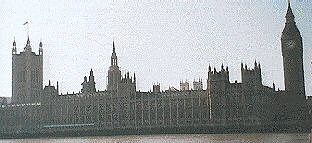
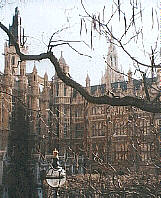
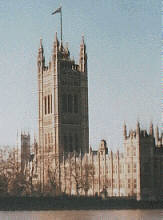
| Originally the site that is called The Palace of Westminster and encompases The Houses of Parliament was a Royal Palace, occupied by kings, from Edward the Confessor who was crowned in 1043 to Henry VIII crowned in 1509. In 1512 the Palace was damaged by a fire, and ceased to be a royal residence but remained a palace. Westminster Hall is the oldest part of the building that survives, built in 1097 by William Rufus, Edward the Confessor's Hall lay to the south. The roof of the Hall was damaged by fire in 1941. It has also been flooded several times. Over the years many people have altered and re-built The Houses of Parliament, but what you see now is the result of Pugin's vision for our seat of government. | |
Up in flames again. | |
|
On October 16th 1834 The Houses of Parliament went up in flames. Pugin had been one of the spectators when the building burnt down. He was not sorry, to see the work of some of the architects he loathed, notably Soane and Wyatt, burn to the ground.
It was decided that there would be a competition to choose who would be given the task of designing the new building. There was a condition to the competition, saying that the building should be either Elizabethan or Gothic in style, which greatly pleased Pugin. |
Other work | |
|
At the time he was working on some designs for Charles Barry who was building a Grammar school in Birmingham.
He was also doing some work for Gillespie Graham, who he had met in Scotland, just after he had been shipwrecked. Graham gave him a compass, and made Pugin promise he would not give up architecture. |
|
|
Barry and Graham were impressed by both the speed and the detail of Pugin�s drawings. Barry asked Pugin for his help in producing some drawings for the new Houses of Parliament.
The competition was won by Charles Barry in January 1836. In August of the same year Barry was asked to produce drawings for all the fixtures and fittings, in order to enable a detailed estimate to be made, for the cost of the work and again Barry asked for Pugin�s help. | |
Working with old friends | ||
| Pugin worked on the project for a further six months, he was now becoming a well known architect, designer and writer. In 1844 Barry appealed to Pugin to assist him again with the decoration, woodwork, tiles, glass and metalwork. This involved Pugin's old friends, John Hardman, Herbert Minton and John Crace who were able to understand Pugin and the way he worked. |
|
The foundation stone for the Houses of Parliament was laid in April 1840 and they were not opened until 1847, work was still going on and some rooms were unfinished at the opening, in fact it was still incomplete at Barry�s death in 1860.
Pugin is said to have made over two thousand drawings for furniture, wallpaper, soft furnishings, tiles, woodwork, and metal work for the House of Lords. Charles Barry was knighted the year Pugin died. |
The restoration of the Lord Chancellor's apartments | |
|
March 1998
Restoration by it's very nature is an expensive business, money well spent enables future generations to enjoy it's presence. In lauding the achievements of the past we can celebrate the future in good heart. Even if it is in the shape of a billion pound plastic bubble due to last 18 months, as opposed to Pugin's building that has lasted 158 years and counting. Posterity will record what foresight Lord Irvine and his advisors had and thank them for it. April 1998 Still the controversy continues, with the tabloids having gained entrance to the said apartments, likening them to have been decorated in the style of an 'up-market Indian restaurant', decorated in 'autumnal biriani' and 'bilious orange'. For all the protestations, the restorations have been carried out successfully. I wonder what Alison Pearson and Sebastian Faulks of the London Evening Standard will whine about next. September 1998 I visited the apartments this morning, and I wondered if the two hacks from The Standard had been to the wrong place? I certainly did not recognise their description of the place. I was very impressed with what I saw, the overall effect would have met with Pugin's approval. The rooms are without doubt stunning, the views of London are amazing. The wallpapers, the soft furnishings, the blinds are all faithful reproductions of his original designs, not only that, they were made in the same manner as they would have been in the 1840's. The tables are originals, wonderful to see them in such good condition. Money well spent, no doubt about that. The restoration was all part of a rolling program to restore the whole of the Palace of Westminister and the plans were already in motion when Lord and Lady Irvine took up residence. | |
| I would like to point out that this is an independantly built and constructed website and the opinions within it are my own. |