Pugin's Home life

The Home

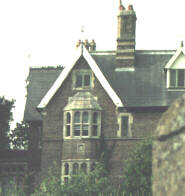
Pugin's House The Grange Although Pugin travelled extensively his base at home was The Grange, Ramsgate, Kent.

This is the house that he built for himself and his family, it was completed in 1844. Overlooking the sea, it has wonderful views.

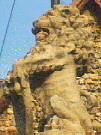
The house which is quite austere, is reached through large wooden gates off the street with carved lions sitting on the gateposts, which were added by Edward. Through the gate you walk into a courtyard, with what was the kitchen, larder and scullery on the left, this extension to the main body of the house was also added by Edward. There is an attractive glazed and tiled entrance hall added by Edward, which leads to heavy oak doors and the main entrance to the house.
Inside

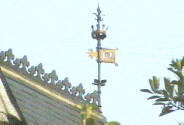
roof of the house Inside, a distinctive staircase leads up from the hall, the banisters of which are in the shape of angled H's. The hallway was always full of heavy coats and souwesters, telescopes and other paraphernalia to protect against the inclement weather.
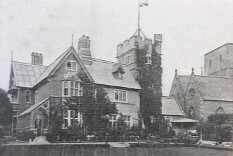
To the right of the hall is the drawing room, and from the garden side the house is fronted by the library on the left, where Pugin used to work; next to that is the dining room. Above the library was Pugin's bedroom.

To the side of the dining room is the family chapel attached to the house where Pugin presided over prayers at 8am and again at 8pm in the evening for Compline. The chapel was small with tiles on the floor similiar to those in St. Augustines Church. The windows are all stained glass. In cold weather there was always a stove burning, Pugin felt one prayed better when warm.

Working

stone lion on the gateway As you stand in what was an attractive garden the room that you now see to the left of the library is an extension which was added on by Edward Pugin. The large garden which overlooks the cliffs, was tended by an old gardener.

This is the house where Pugin entertained his friends and associates, and where his pupil John Hardman Powell lived. It was a jolly home with his large family, and they had many visitors who were always asssured of a warm welcome.

Pugin worked in the library with a curtain through to the drawing room instead of doors, he disliked the sound of slamming doors (inevitable with eight children in the house) and of the doorbell, which he said used to distract him from his work. The house was run in a routine with prayers morning and evening taken by Pugin.

Friends

photgraph of the Grange The larder in the house was always full of provisions, and although Pugin did not drink or smoke he was generous in his hospitality.
Some of the many people whom Pugin entertained at The Grange included his patron, The Earl of Shrewsbury and Sir John Lambert whom Pugin met when he lived in St. Maries Grange near Salisbury (the first house he built for himself), and who was a solicitor he shared a love with Pugin for Gregorian music.

Dr. Daniel also came often, he was the family doctor and lived in Ramsgate. Father Thomas Costigan who was a local Priest and sometimes celebrated Mass in Pugin's church. Other friends included Talbot Bury an Architect, the Thorntons from Sturry who had children the same age as Pugin's, and many other people, including Jane Pugin's cousin, Stuart Knill.

By ten o'clock at night all work ceased and the house was locked and bolted for the night. Pugin had a dread of being burgled, and was also concerned about the anti-catholic feeling that he encountered. The impression is one of a happy home with fires burning, plenty to eat and a convivial atmosphere.

Neighbours

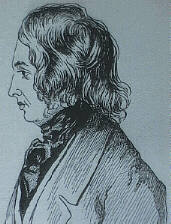
Charles Dickens the author rented Fort House in Broadstairs also with lovely views, two miles from The Grange. Dickens was Pugin's elder by a month it is rumored that Dickens disliked Pugin. A line drawing of Dickens aged 29 Pugin's other neighbour was Sir Moses Montefiore who lived in East Cliff Lodge in Ramsgate. He was a philanthropist, Jewish and well respected, born in 1784 and living to be 101. He was twenty eight when Pugin was born. Pugin mentions Montifiore with respect.

Boat

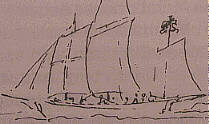
sketch by Pugin of his boat Pugin once said 'There is nothing worth living for but Christian Architecture and a boat'. The Grange has a tower, from which Pugin used to watch the sea for ships that frequently fell into trouble off the Goodwin Sands.

He used to go out and rescue the crew and the boats in his Wrecker 'The Caroline', this undoubtably supplemented his income in salvage money.

This is Pugin's own sketch of his boat.


Return to the Pugin Home Page
This original work was created for the World Wide Web by Victoria Farrow, with the support of the Pugin Society. It was constructed by Mike Farrow of Channel Business Internet Systems.