St. Francis Church and Monastery of St. Francis of Assisi, Gorton, Manchester.
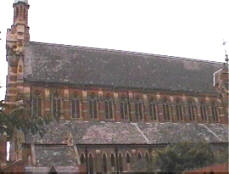
St. Francis Church and Monastery of St. Francis of Assisi, Gorton, Manchester. | |
|
|
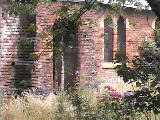
This has got to be the most depressing of the lot. The one time glory of this place is evident for all to see, as is the mountain of bird droppings on the steps of the sanctuary, the broken windows, lost doors smashed carvings of every description all piled up in what would have been the Lady Chapel. The smell of rot, decay and urine was overwhelming. The only feeling of hope was the flowers poking their heads through the tangle of weeds in the sunshine, in the little monastery garden. |
| Edward built this large church and monastery begining in 1862, it was for the Fransiscan Friars. They came to Gorton to administer to the poor and needy of the area which was mainly Irish and Italian Catholics probably working in the cotton mills. They lived in the tiny terraced houses near to the monastery and made up a loyal congregation, helping with the building of it. In the 1970's the houses were demolished and the community was dispersed with the worshippers gone, the friars moved out in 1989. |
| |
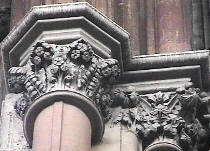 |
The Monastery is a Grade 2 listed building, it is on English Heritage's at risk register. It certainly is of stunning proportions, the monastery is largely demolished. The church at it's highest point inside is over one hundred feet. In it's demise it is no less impressive, birds flew in and out while we were there, and the extent of the vandalism is very painful to witness. The pictures speak for themselves. | |
|
This area of Manchester has seen better days, the first attempt at lottery money to turn the buildings into a multi cultural, multi faith resource centre fell at the first hurdle. Now the Heritage Lottery Fund has given 2.77 million to turn this thrilling church into a hotel, workshops and community centre.
Perhaps those concerned should have visited St. Francis Church Glasgow, by Peter Paul Pugin to see how it is done. If you would like to know more do email [email protected] | 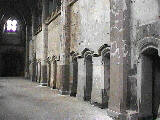 |
|
Our Lady of Charity Convent, Bartestree, Hereford.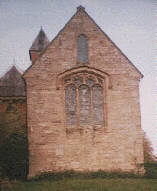 The buildings were started in 1862 by Edward Pugin, ten years
after his father's death. It is a listed site and has been empty since
1993.
The buildings were started in 1862 by Edward Pugin, ten years
after his father's death. It is a listed site and has been empty since
1993.
All the buildings are in a sad state of disrepair. The nuns who lived here for 130 years were from an order founded in France in the 17th century, to care for 'fallen women'. This is a large site one of the buildings is a Medieval chapel, which was moved from another place and re-built it has a Hardman window, of the resurection. This chapel has been vandalised but the window remains intact. |
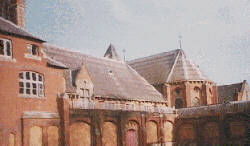 The owner of the land Robert Biddulph Phillips was a well respected landowner. He gave the land which was part of his estate together with some money to the sisters of Caen for a convent.
Phillips was born in 1798 and married his wife Elizabeth in 1834. She died in 1852 his daughter Mary Ann also died around this time. Phillips became a catholic in 1851, and on their deaths gave the land to the nuns. |
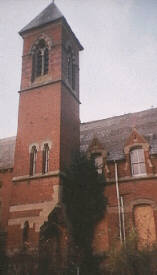 The nuns fell into debt, after a scheme to turn their expansive property into a care village, failed to sell. The creditors won a court order to aquire the property and sell it to pay the debts. The owners, Millview Developments of Liverpool have been unable to find a good use for the buildings.
This whole site desperatley needs help. A plan to build 50 houses opposite the convent to finance restoration work has been implemented by South Hereford District Council however no work on the convent has been forthcoming. If you would like to learn more, write to: Mr. S. Jones, Principal Planning Officer, 35 Hafod Road, Hereford HR1 1SH |
Loreto Abbey, Rathfarnham, Nr. Dublin, Eire.Originally the building was called Rathfarnham House, built in 1725 for William Palliser the Protestant Archbishop of Cashel. Designed by Edward Pearce it was built as two storeys in the Paladian style.In 1789 it changed hands, bought by G. Grierson who had it until 1800. It was empty until 1821 when Archbishop Murray bought it for the Loreto nuns, they moved into the building in 1822 and re-named it Loreto Abbey. The chapel within the church was designed by Patrick Byrne in collaboration with Pugin in 1839. It has a lovely altarpiece, supported by two kneeling angels by John Hogan built in 1848. This building is currently a secondary school and shortly it will be put on the market. The concern is that it will be purchased by a property developer. |